Writing question
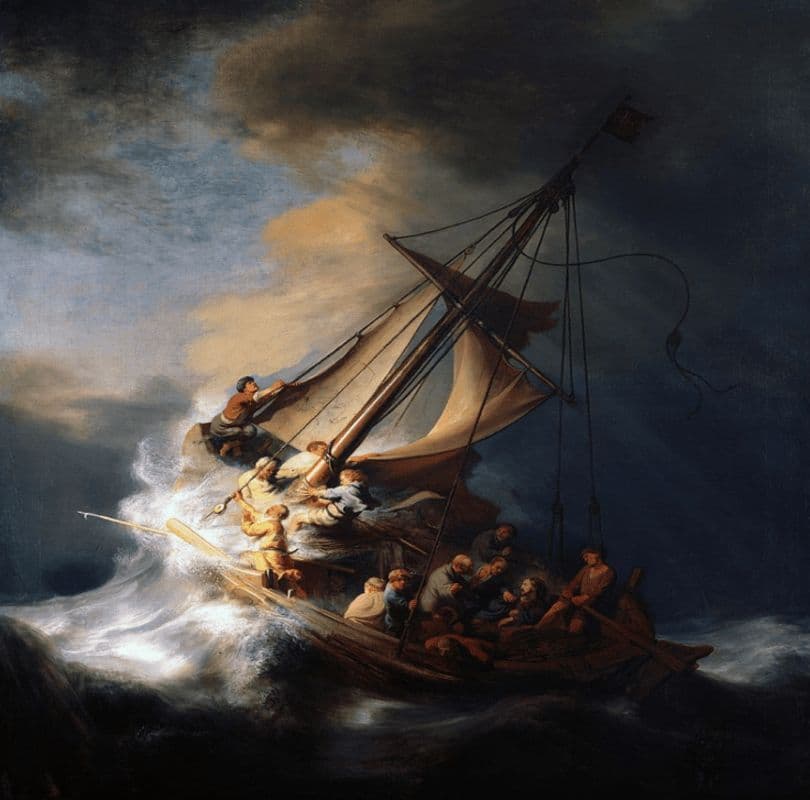
Write a creative response to this picture:
The Storm on the Sea of Galilee Rembrandt (1633)
Imagine you were one of the people in the picture and describe the scene, your feelings and your observations as if you are that character.
Practise this exact question with personalised feedback on your writing.
Understand the task
Enter the painted boat as one of its occupants. Describe the storm, fellow passengers and fear through the character’s immediate senses, anchored in the image’s visible features.
- first-person immersion
- visual evidence
- sensory description
- emotion
Requirements to keep in mind
Write from the viewpoint of someone inside Rembrandt’s painted boat.
Plan your response
- Write as one person pictured in the boat.
- Borrow visible details such as the sail, waves and figures.
- Use “I” to show thoughts as well as actions.
- Describe physical sensations in rough weather.
- Let the character’s emotions develop during the scene.
Check your response against the task requirements. Leave time to review sentence clarity, punctuation and spelling.
Original atoply example response
Written by atoply, not an official school answer or mark scheme. Other successful responses are possible.
Reveal example and teaching notes
The boat lurched so sharply that my knees struck the wooden boards. Cold spray slapped my face, filling my mouth with salt.
“Hold the rope!” shouted the man beside me. I could barely hear him above the wind. The sail cracked overhead like a giant whip, and our little vessel climbed a wave that seemed taller than the mast.
For an instant, I saw everything: the pale patch of sky beyond the clouds, the figures clinging to the boat, the black water falling away beneath us. Then we dropped into the trough, and darkness closed around us again.
My hands burned where the wet rope rubbed against them. I was frightened, not only of the sea but of the helplessness on every face. One man bent over the side, overcome by the motion; another strained to keep the sail from tearing free.
“Will we reach the shore?” I asked, though the answer was swallowed by thunder.
A sudden opening appeared in the clouds. Light struck the sail, turning its soaked cloth almost golden. The sea was still wild, but I could now make out the distant line where water met sky.
I tightened my grip. We were not safe yet. Nevertheless, as we hauled together against the wind, I felt something stronger than my fear: the stubborn hope that we might survive.
Learn from the example
- Concrete details build an impression of the subject. Notice how those choices work together rather than reading as a list of general adjectives.
- The viewpoint controls what the reader notices. Choose details and an order that sustain the task's requested perspective and atmosphere.